Why the kick and sub decide the drop
Take a peak-time drop back to its bare bones and you're left with a four-on-the-floor kick and a sub rolling underneath. Everything else, from the lead to the supersaws, sits on top of that. If those two aren't working together, fixing things further up the mix won't save it.
The usual sign is a loop you can't get out of. You turn the kick up and the sub goes missing, then bring the sub back and the kick loses its punch. Level alone may not solve it. Check the note choices and timing as well as the balance. Where the sounds overlap, their phase relationship can matter too.
It matters more here than anywhere else because of where the track gets played. A club system can expose low-end problems that smaller monitors conceal, and the low end may be summed to mono. A clash you can barely pick out at home can turn into a hole or a boom on a big system.
Where the clash actually happens
In a straight off-beat pattern the sub plays between the kicks. Overlapping tails are the first place to check for masking and phase interaction: the kick tail is still ringing when the sub note starts, a sub note hangs on into the next kick, or a glide passes through the kick's pitch. Rolling basslines fill more of the beat, so note lengths and ducking matter even more there.
One beat at 140 BPM (429 ms)
The kick has died away by 180 ms and the sub starts at 214 ms, so there is a small gap. The sub note also finishes before the next kick.
Reading the kick
The attack cycles are packed tight, spread out as the pitch falls, and shrink as the tail fades.
Reading the sub
The cycles are evenly spaced because the pitch holds steady. The note fades in and out gently, and the sub leaves the first half of this example free for the kick.
Level sets which one leads. Timing is about whether they take turns cleanly, and where they do overlap, pitch and phase change how the two waveforms add up. Sort those out at the source and most of the fader-riding goes away.
The fix order
Mix Lock works on the low end from the bottom of the chain upwards: the channel before the group, and the sound itself before any processing. This is the short version for the kick and sub.
1. Commit to the kick and make it the anchor
Pick the kick and stop swapping samples. Mix Lock uses −6 dBFS peak as its kick reference. That number is a choice: the template's other level targets and headroom are built around it. In the Mix Lock template, keep the kick mono and route it straight to the master to keep its transient independent of drum-bus compression.
There is no single correct kick level for every setup. Some producers work with more headroom, some with less, and some adjust the overall mix level before mastering. In your own session, choose a reference that suits how you work and build the balance around it, keeping enough headroom throughout the signal path. The useful part is having a consistent anchor.
2. Clear the off-beat
At 140 BPM the off-beat lands at about 214 ms, so a kick tail of 150–200 ms is a useful starting point for leaving space before the sub enters. A longer tail can still work. If it rings past the sub's entry, listen to the pair together: that overlap may blur the off-beat, depending on how much of the tail remains and how the sounds interact. Shorten it if the groove sounds smeared.
These timings are for 140 BPM and vary slightly with your track's tempo. Use them as a starting point, then judge the kick tail against your bass pattern by ear.
3. Get the sub's note right at the source
Before touching any processing, check that the sub notes and octave fit the intended harmony. A root-note pattern is a useful starting point in Mix Lock, with the lower register providing the weight. Confirm the actual notes and frequencies at the source; EQ cannot retune an incorrect note.
4. Make a pocket if the pair needs one
If the overlap is masking the kick, try a small dip in the sub around the competing frequencies or enough ducking to let the kick through. Use either or both as needed, and compare with them bypassed. If the pair already works, leave it alone. Too much cutting or ducking can take away the weight.
5. Set the sub level last
After any timing or processing changes, Mix Lock's starting point for the sub is about 2–3 dB below the kick at peak. Use that as a relative guide, then judge the balance in your own session. Because the sub sustains between kicks, it carries more energy than the peak reading alone suggests.
6. Check in mono, then on small speakers
Switch to mono and check that the low-end weight survives. On small laptop or phone speakers, much of the sub fundamental may disappear, so the harmonic bass layer needs to carry the line. Headphones and earbuds vary; some reproduce deep bass well. Hearing the sub on them does not mean it is too loud. Compare with a level-matched reference on the same system.
Common mistakes
Turning the kick up to win
Before turning up a lost kick, check what is masking it. If the balance is already close, more level can cost headroom without solving the clash. Use the anchor as your reference, then judge whether the level or the competing sounds need attention.
Letting the kick tail ring into the off-beat
A long, boomy tail can sound great soloed, then drag the groove once a rolling sub is playing. Shortening the sample or its amplitude envelope is usually the most direct fix. Use a short fade when trimming audio to avoid a click. Bus compression can reshape the envelope too, but it also affects the other sounds routed through it.
Judging the sub from audibility alone
A sub can have an audible pitch, especially on headphones or a full-range system. In Mix Lock, keep its role focused on low-end weight and use the mid bass for most of the growl and character. Check the actual note, register and balance before deciding that an audible sub is wrong.
Fixing a wrong note with EQ
A wrong note can conflict with the intended harmony; an unsuitable octave can leave the low end thin or crowded. Check the note and register at the source before using level or EQ to compensate. EQ cannot retune an incorrect note.
Carving too much
A deep dip and heavy ducking can feel like the fix until the drop starts sounding thin. Check that the sub keeps its weight between kicks and that any pumping suits the groove.
Gliding through the kick
A glide through the kick's range can blur the attack if the two overlap strongly. If that happens, try moving the glide into the gap or adjusting the note length and ducking.
Reverb on the kick or sub
For Mix Lock's tight low end, keep the core kick and sub dry. Uncontrolled low-frequency reverb can fill the gaps and blur the groove. Filtered or carefully timed effects can work, but check that the weight and attack survive.
Faking impact with processing
Extra click and saturation can make a kick more noticeable without supplying the low-end weight you want. Start with a kick whose body suits the track; swapping it may be simpler than rebuilding it with processing.
How Mix Lock walks you through it
What's above is a cut-down version of what Mix Lock teaches on its Kick and Sub channels. In the app you start with the symptom, described the way you'd say it, and it points you to the likely cause and the channel to look at first.
Start from the problem
The Problems database has 300 mix problems phrased as symptoms you can recognise. Filter to low end and the kick and sub clashes are listed by name, each tagged with the channels involved.
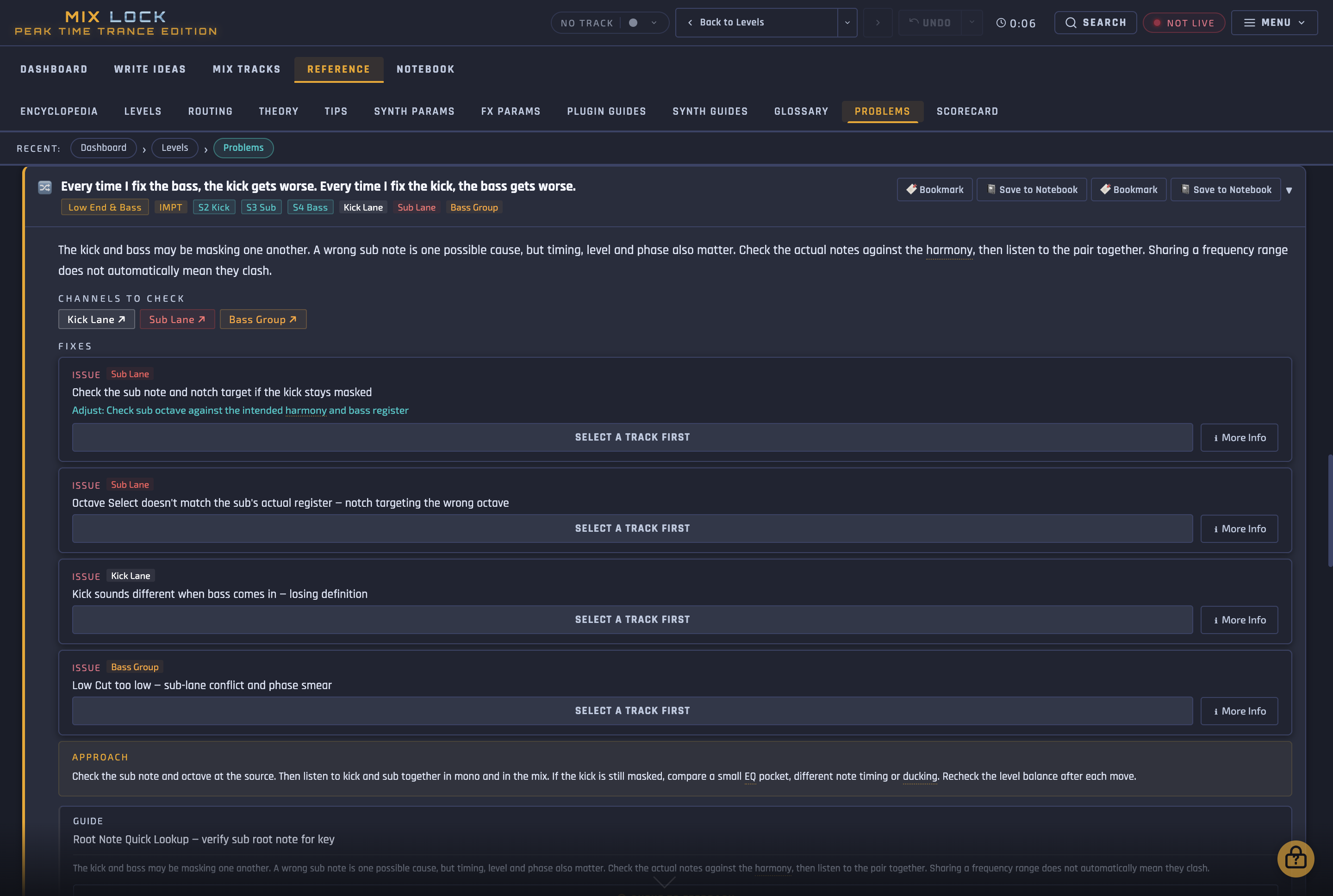
“Every time I fix the bass, the kick gets worse. Every time I fix the kick, the bass gets worse.”
- Channels
- Kick Lane · Sub Lane · Bass Group
What's going on
The kick and bass may be competing in the same range. Check whether the sub note and octave fit the track, then listen to their timing and balance. A wrong note needs correcting at the source; level changes alone cannot retune it.
Where to start
Check the sub note and octave first, then listen to the pair together. If the kick is still masked, try a small pocket in the sub or adjust the timing and ducking. Recheck the level balance after each change.
Then work the channel
Each problem links through to its channel in the Encyclopedia, which explains every control on the template's rack for the value you've set it to. Here's one control on the Sub Lane, in brief.
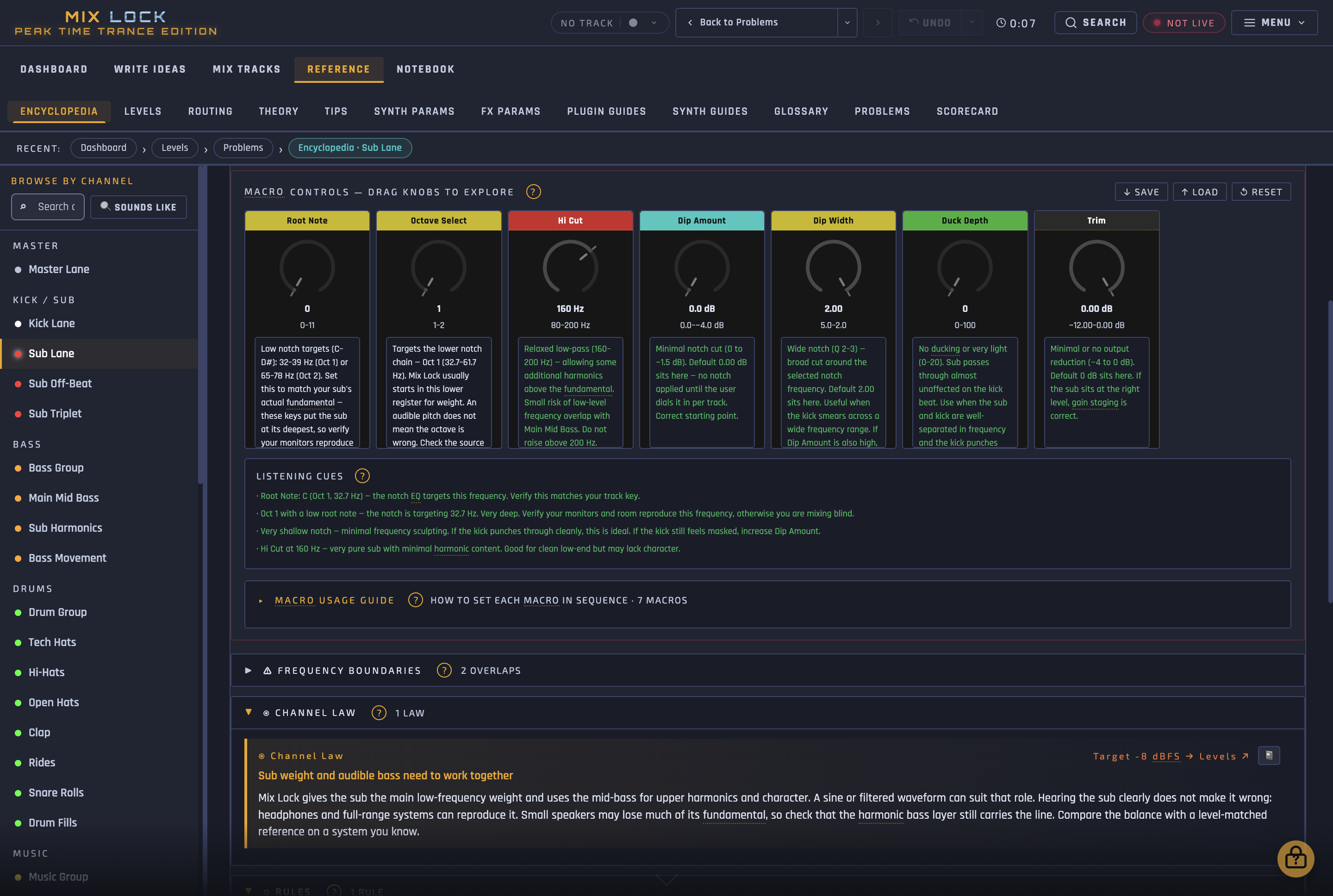
How deep should the Sub Lane pocket be?
- Control
- Dip Amount
- 0 to −1.5 dB: Little or no cut. Leave it here until you've confirmed the sub's note.
- −1.5 to −3 dB: A moderate range to audition in Mix Lock when the pair needs a pocket. Compare with the cut bypassed and keep the sub full.
- −3 to −4 dB: A stronger cut for a persistent clash. Use it only if the comparison sounds better, and back off if the sub turns hollow.

What this guide leaves out
The full version goes much further on these two channels:
- The kick and sub problems covered in Mix Lock, with likely causes and paths to investigate
- A note-and-octave frequency lookup to help set the Sub Lane notch controls
- Guidance for each position of all 13 kick and sub controls
- Level targets for every channel in the template, relative to the kick