The short answer
In most peak-time trance the sub plays on the off-beat, between the kicks, so clashes usually come from overlap. At 140 BPM that off-beat arrives about 214 ms after each kick. Start with a kick tail of around 150–200 ms, get the sub's note and octave right at the source, cut a little space for the kick only if it still sounds buried, and set the sub about 2–3 dB below the kick at peak before judging the balance by ear.
Why the kick and sub decide the drop
Take a peak-time drop back to its bare bones and you're left with a four-on-the-floor kick and a sub rolling underneath. Everything else, from the lead to the supersaws, sits on top of that. If those two aren't working together, fixing things further up the mix won't save it.
The usual sign is a loop you can't get out of. You turn the kick up and the sub goes missing, then bring the sub back and the kick loses its punch. Level alone may not solve it. Check the notes and the timing as well as the levels. Where the two sound at the same time, their waves can also partly cancel each other out, which is a phase problem.
It matters more here than anywhere else because of where the track gets played. A club system shows up low-end problems that smaller speakers hide, and many clubs play the bass in mono. A clash you can barely pick out at home can turn into a hole or a boom on a big system.
Where the clash actually happens
In a straight off-beat pattern the sub plays between the kicks. That means the first thing to look for is overlap, where one sound is still playing when the other starts. That might be the kick's tail still ringing when the sub note begins, a sub note that carries on into the next kick, or a sub note that slides up or down in pitch just as the kick hits. Rolling basslines fill more of the beat, so note lengths and ducking matter even more there.
One beat at 140 BPM (429 ms)
The kick has died away by 180 ms and the sub starts at 214 ms, so there is a small gap. The sub note also finishes before the next kick.
Reading the kick
At the start the waves are packed tightly together. They spread out as the kick's pitch drops, then get smaller as the tail fades away.
Reading the sub
The waves are evenly spaced because the sub holds one note. It fades in and out smoothly, and in this example it stays silent for the first half of the beat, which leaves room for the kick.
The level decides which one leads, and the timing decides whether they take turns cleanly. Where they do overlap, their notes and the way their waves line up change how they sound together. Fix those in the sounds themselves and you'll spend far less time riding faders.
The fix order
Mix Lock fixes the low end in a set order: the individual channel before the group it feeds, and the sound itself before any plugins. This is the short version for the kick and sub.
1. Commit to the kick and make it the anchor
Pick the kick and stop swapping samples. Mix Lock uses −6 dBFS peak as its kick reference. That number is a choice: the template's other level targets and headroom are built around it. In the Mix Lock template, keep the kick mono and send it straight to the master channel, so the compressor on the drum bus doesn't soften its initial hit.
There is no single correct kick level for every setup. Some producers work with more headroom, some with less, and some adjust the overall mix level before mastering. In your own session, choose a reference that suits how you work and build the balance around it, leaving enough headroom at every stage so nothing clips. The useful part is having a consistent anchor.
2. Clear the off-beat
At 140 BPM the off-beat lands at about 214 ms, so a kick tail of 150–200 ms is a useful starting point for leaving space before the sub enters. A longer tail can still work. If it's still ringing when the sub comes in, listen to the two together. Depending on how much tail is left, the overlap can blur the off-beat. Shorten it if the groove sounds smeared.
These timings are for 140 BPM and vary slightly with your track's tempo. Use them as a starting point, then judge the kick tail against your bass pattern by ear.
3. Get the sub's note right at the source
Before touching any processing, check that the sub is playing the right notes, in the right octave, for the track's chords. In Mix Lock the usual starting point is the root note of each chord, played low for weight. Check the notes on the synth or in the MIDI itself, because EQ can't fix a wrong note.
4. Make space for the kick only if it needs it
If the kick still sounds buried, try a small EQ cut in the sub where the two clash, or a little sidechain ducking so the sub dips when the kick hits. Use either or both, and compare with them switched off. If the pair already works, leave it alone. Too much cutting or ducking can take away the weight.
5. Set the sub level last
After any timing or processing changes, Mix Lock's starting point for the sub is about 2–3 dB below the kick at peak. Use that as a relative guide, then judge the balance in your own session. Because the sub keeps playing between kicks, it sounds heavier than its peak reading suggests.
6. Check in mono, then on small speakers
Switch to mono and check that the low-end weight survives. On small laptop or phone speakers, much of the sub's lowest note can disappear, so the mid bass needs to carry the bassline. Headphones and earbuds vary, and some play deep bass well. Hearing the sub on them does not mean it is too loud. Compare with a reference track at the same volume, on the same speakers or headphones.
Common mistakes
Turning the kick up to win
Before turning up a kick that's getting lost, find out what's covering it. If the levels are already close, turning it up eats headroom without fixing the clash. Keep the kick at your reference level and work out whether it's the kick or the other sounds that need changing.
Letting the kick tail ring into the off-beat
A long, boomy tail can sound great soloed, then drag the groove once a rolling sub is playing. Shortening the sample, or its decay on the sampler or synth, is usually the quickest fix. Add a short fade when you trim audio so it doesn't click. A compressor on the bus can change the tail too, but it also changes everything else going through that bus.
Assuming a sub you can hear is wrong
You can often hear the sub's note, especially on headphones or big speakers, and that isn't necessarily a problem. In Mix Lock the sub's job is weight, and the mid bass supplies most of the growl and character. Check the note, the octave and the level before deciding something is wrong.
Fixing a wrong note with EQ
A wrong note clashes with the chords, and the wrong octave can leave the low end thin or crowded. Fix the note and octave in the synth or MIDI before reaching for level or EQ, because EQ can't change a note.
Carving too much
A big EQ cut and heavy ducking can feel like the fix until the drop starts sounding thin. Check that the sub keeps its weight between kicks and that any pumping suits the groove.
Sub notes that slide in pitch as the kick hits
Some sub sounds slide from one note to the next, a setting usually called glide or portamento. If that slide happens right as a kick hits, the kick can lose its punch. Move the slide so it happens between kicks, or shorten the notes so they don't overlap.
Reverb on the kick or sub
For Mix Lock's tight low end, keep the core kick and sub dry. Reverb on low sounds can fill the gaps between kicks and blur the groove. Reverb with the lows filtered out can work, but check the kick still hits hard and the sub still feels solid.
Faking impact with processing
Adding click and saturation makes a kick stand out more, but it doesn't add low-end weight. Start with a kick sample that already has the body you want. Swapping it is often quicker than trying to build that weight with plugins.
Kick and sub questions
How loud should the sub be compared with the kick?
Mix Lock starts with the kick at −6 dBFS peak and the sub about 2–3 dB below it, and the template's Levels page targets around −8 dBFS peak for the sub. Treat those as reference points for the template. The sub keeps playing between kicks, so it sounds heavier than its peak reading suggests, and the final balance should be judged in your own session.
How long should a kick tail be at 140 BPM?
A straight off-beat sub starts about 214 ms after each kick at 140 BPM, so a tail of 150–200 ms leaves room before it enters. That is a starting point for this tempo. A longer tail can still work if the off-beat stays clear when you listen to the pair together, and the timings shift slightly at other tempos.
Should I sidechain the sub or cut some EQ for the kick?
Only if the kick still sounds buried after you've checked the timing and the sub's notes. A small EQ cut in the sub where they clash, a little sidechain ducking, or both can help. Compare with them switched off, and back off if the sub loses weight.
Why does my kick disappear when the bass comes in?
Usually because they're playing at the same time or fighting over the same low frequencies. Check whether the kick's tail runs into the sub, whether the sub is on the right note and octave, and how much sidechain and processing each one has. Turning the kick up can cost headroom without fixing the overlap.
Should the kick and sub be mono?
In the Mix Lock template the kick is kept mono, and it is worth checking the whole low end in mono because many club systems play the bass in mono. If the weight drops away when you switch to mono, look for stereo widening on the kick, sub or bass, or two layers that cancel each other out.
How Mix Lock walks you through it
What's above is a cut-down version of what Mix Lock teaches on its Kick and Sub channels. In the app you start with the symptom, described the way you'd say it, and it points you to the likely cause and the channel to look at first.
Start from the problem
The Problems database has 300 mix problems phrased as symptoms you can recognise. Filter to low end and the kick and sub clashes are listed by name, each tagged with the channels involved.
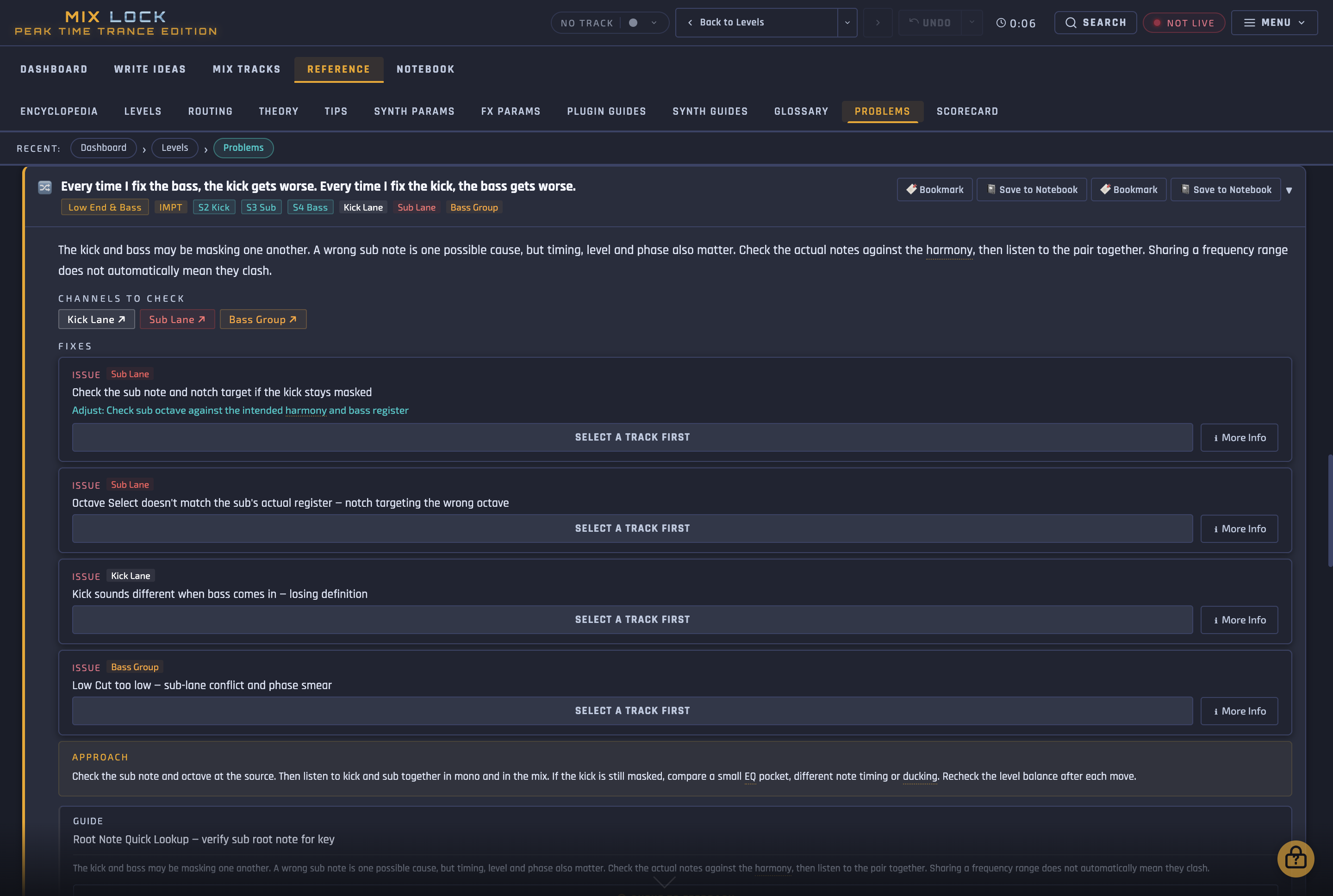
“Every time I fix the bass, the kick gets worse. Every time I fix the kick, the bass gets worse.”
- Channels
- Kick Lane · Sub Lane · Bass Group
What's going on
The kick and bass may be fighting over the same frequencies. Check whether the sub is on the right note and octave, then listen to their timing and levels. A wrong note has to be fixed in the synth or MIDI, because changing levels won't change the note.
Where to start
Check the sub note and octave first, then listen to the pair together. If the kick still sounds buried, try a small EQ cut in the sub or adjust the timing and sidechain. Recheck the level balance after each change.
Then work the channel
Each problem links through to its channel in the Encyclopedia, which explains every control on the template's rack for the value you've set it to. Here's one control on the Sub Lane, in brief.
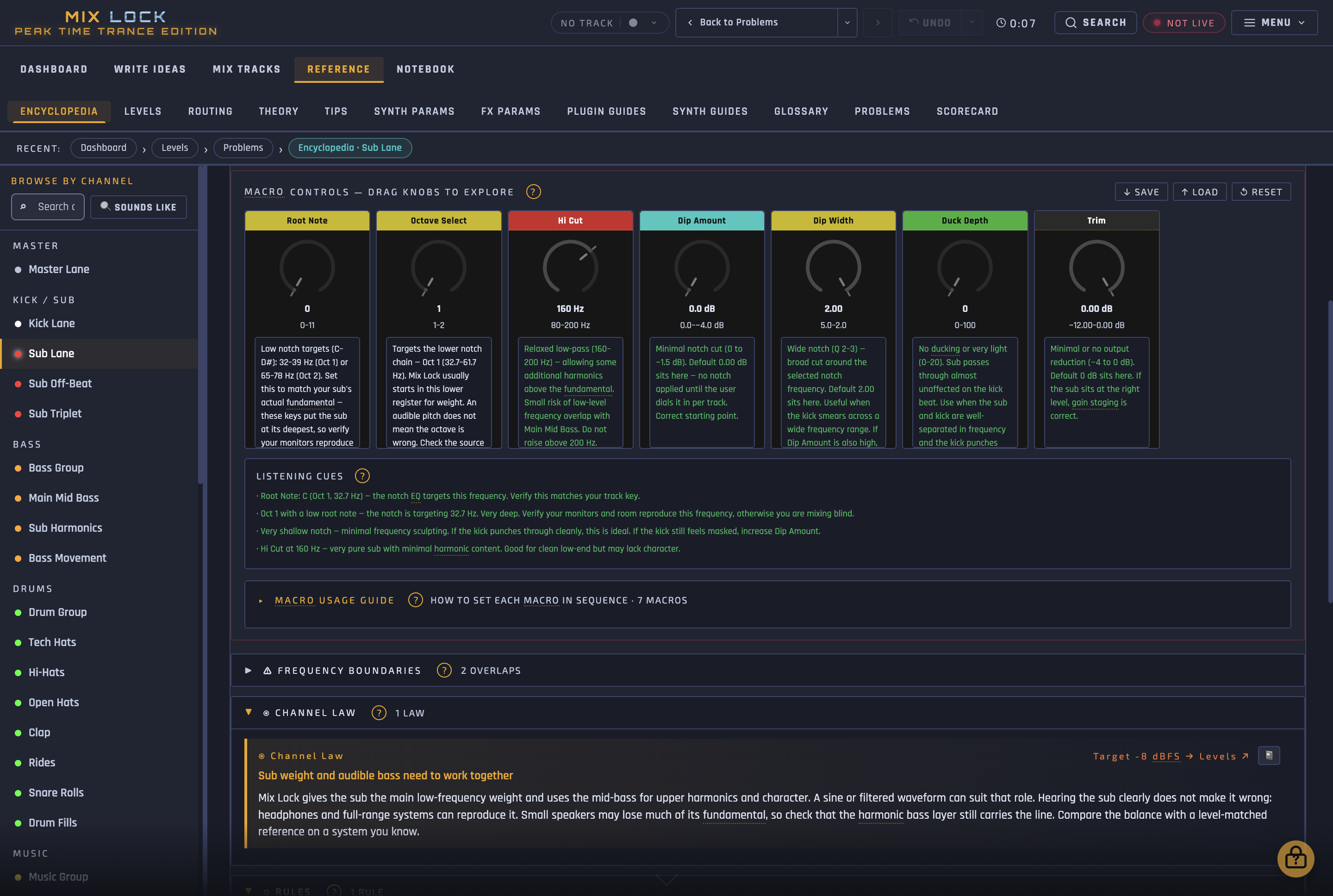
How big should the EQ cut on the Sub Lane be?
- Control
- Dip Amount
- 0 to −1.5 dB: Little or no cut. Leave it here until you've confirmed the sub's note.
- −1.5 to −3 dB: A moderate cut to try when the kick needs more space. Compare with the cut switched off, and keep the sub full.
- −3 to −4 dB: A stronger cut for a persistent clash. Use it only if the comparison sounds better, and back off if the sub turns hollow.

What this guide leaves out
The full version goes much further on these two channels:
- The kick and sub problems covered in Mix Lock, with likely causes and where to start
- A lookup table from each note and octave to its frequency, for setting the Sub Lane's EQ cut
- Guidance for each position of all 13 kick and sub controls
- Level targets for every channel in the template, relative to the kick